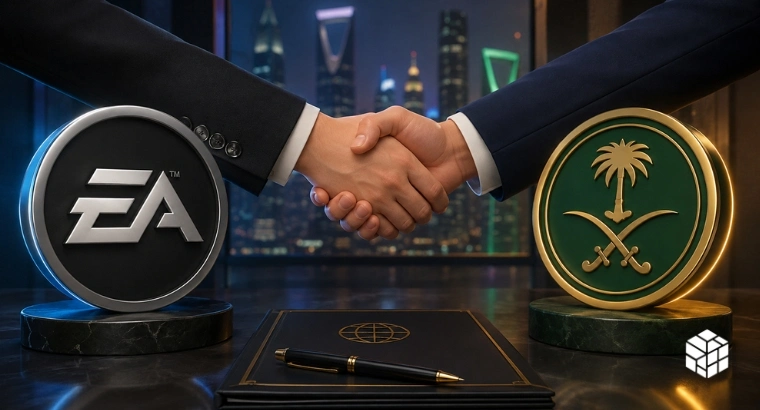
Electronic Arts is no longer a public company, as Saudi Arabia’s Public Investment Fund completed its buyout of the company on August 4, 2026. PIF closed a $55 billion deal that ranks as the largest leveraged buyout ever recorded. The transaction was announced in September 2025 and took eleven months to clear regulatory review, with European approval in July removing the final obstacle.
Although the structure is what has developers rest uneasy. The deal loads billions in debt onto EA itself, which is standard for a leveraged buyout and is also why analysts expect cost-cutting to follow. Nothing has been confirmed as of yet, and EA has not announced any news of layoffs, studio closures, or cancellations tied to the sale.
Who Now Owns EA and What Shareholders Received
The PIF purchase did not include EA alone. It acquired the publisher alongside Silver Lake and Affinity Partners, the private equity firm run by Jared Kushner. PIF already held a 9.9% stake in EA, which rolled into the deal. Silver Lake co-CEO Egon Durban previously sat on Unity’s board.
EA stockholders receive $210 per share, roughly a 25% premium on the price before the deal became public. With the transaction closed, EA leaves the stock market, and its quarterly financial disclosures end.
Andrew Wilson remains chief executive. He has held the role since 2013, a period in which EA’s share price climbed from around $27. Company filings show he received $38 million in total compensation in the last fiscal year, during which EA laid off developers including staff who had worked on Battlefield 6.
In terms of scale, this is not the largest gaming acquisition on record. Microsoft paid $75.4 billion for Activision Blizzard on October 13, 2023. PIF has bought into games before, taking Scopely and Niantic’s gaming division, which also includes Pokémon Go.
Why BioWare and Sims Developers Are Concerned
Developers at BioWare have said they fear the studio could be among the first to face cuts under new ownership. Patrick Weekes, a longtime BioWare writer laid off in 2025, speculated on Bluesky that the new owners might want to steer away from politics their leadership disagrees with. BioWare is known in part for inclusive storytelling and characters.
Buyers: So your games… guns and football, yes? EA: Mmhmm, mmhmm, mostly guns and football, yep. Buyers: No gay stuff? No politics we're not going to like? EA: Haha, definitely not! Hey, could you give me one sec? I just need to shut down a studio real quick. kotaku.com/report-saudi…
— Trick Weekes (@trickweekes.bsky.social) 27 September 2025 at 01:25
[image or embed]
The reaction has not been confined to studios. Cosplayers staged a protest at EA’s California headquarters over the buyout earlier this year.
Analysts expect financial pressure regardless of creative direction. Piers Harding-Rolls of Ampere Analysis said EA may look to “cut excess spending and rationalize the company’s workforce” to service the debt. The Financial Times reported EA could lean further into AI tools to reduce development costs, something the company had already said it was pursuing. Mat Piscatella of Circana told GI.biz that leveraged buyouts have not historically worked out well for the companies acquired.
You can also read – 15 Best Action-Adventure Games To Play In 2026 Across PC And Consoles
What EA’s Final Public Earnings Showed
EA filed its last public earnings report a day before the deal closed. Net bookings of $1.35 billion for the April to June quarter rose $51 million year over year but came in below analyst estimates, according to Reuters. Additional content sales for Apex Legends helped, as did full-game and microtransaction revenue from Battlefield 6. Lower sales of Split Fiction offset part of the gain.
Take-Two is now the largest public independent pure-play video game publisher, as EA went private today after being sold to Saudi Arabia’s Public Investment Fund for $55 billion.
— GTA 6 Countdown ⏳ (@GTAVI_Countdown) August 5, 2026
Ironically, EA offered to buy Take-Two for $2 billion in 2008 right before the GTA 4 launch, but… pic.twitter.com/vfqy443tS5
Not everyone reads private ownership as a negative. Fiona Sperry, formerly head of EA’s Criterion Games and now chief executive of Three Fields Entertainment, has argued that going private could free teams from designing to a date set long before a game is finished. Harding-Rolls made a related point, noting EA is no longer answerable to public markets and could weigh longer-term investment. The consortium will set its own performance targets, and the debt remains either way.
From here, EA’s numbers go dark. Whatever the debt forces the company to do will surface through announcements and departures rather than filings.